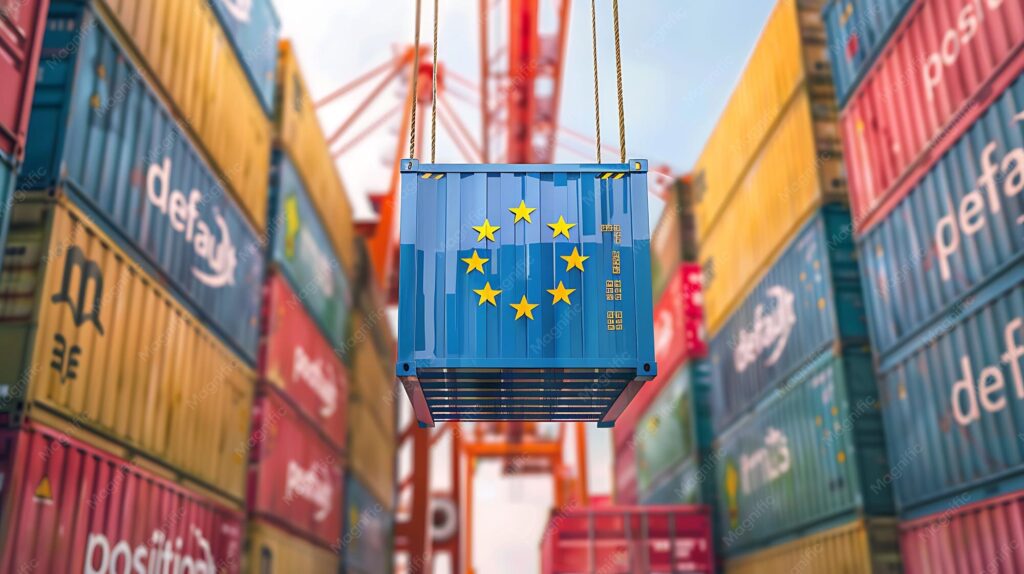
The distribution and e-commerce market in Europe operates in one of the most complex geographical and regulatory environments in the world. The need to work with fragmented transport structures, coupled with increasing sustainability demands and unforeseen events in global supply chains, compels companies to seek technological solutions that go beyond simple predictive analytics.
In this scenario, the Agentic AI in European logistics It emerges as the definitive evolutionary leap, leaving behind traditional and static software systems to give way to autonomous systems capable of reasoning, proposing and executing actions in complex contexts.
The difference between classic automation and agentic systems
During the last decade, automation in the transport sector has been based on rigid rules of the type «"If A happens, then do B"» (if-this-then-thatWhile this approach is useful for simple mechanical tasks, it breaks down in the face of the real volatility of the supply chain, where a delay at a customs hub or a local transport strike requires evaluating multiple variables simultaneously.
Unlike traditional systems, agentic AI stands out for three differentiating capabilities:
- Adaptive autonomy: It does not depend on pre-configured rules; it understands the ultimate goal (for example, “Minimize delivery costs by guaranteeing the SLA before 6:00 PM”) and evaluates the best path in real time.
- Understanding the multimodal context: It can simultaneously process structured data from a CSV delivery note, real-time weather updates, and the historical behavior of a specific carrier in a given province.
- Interaction and execution capacity: Agents don't just display a bar chart on a dashboard; they interact with the digital ecosystem to prepare for the resolution of a problem from start to finish.
[Traditional Software] ➔ Displays a delayed packet on a map. [AI Agent] ➔ Detects the delay, searches for alternative stock, calculates the cost impact on three different carriers, and drafts a solution proposal for the operator.
The specific challenges of the supply chain in Europe
Cadenity's vision on the implementation of the Agentic AI in European logistics It addresses three critical challenges of the community market:
1. Endemic multi-carrier fragmentation
Unlike more unified markets such as the United States, operations in Europe require combining global carriers with specialist local operators in each country (France, Germany, Benelux, Spain, etc.). Centralizing and standardizing this information without compromising the agility of local partners is an insurmountable technical challenge for traditional, rigid platforms.
2. The need for "Zero Disruption" solutions«
European companies can't afford 18-month technology consulting projects or massive migrations of their core ERP or TMS systems to start seeing results. Agent AI must be able to "ride on top" of existing infrastructure, absorbing standard formats like CSV files or lightweight API connectors to deliver value from week one.
3. The linguistic and operational factor in customer service
Managing cross-border incidents requires multilingual interaction. An intelligent agent capable of resolving queries and writing technical explanations in both Spanish and English, directly and natively based on the shipping data, drastically reduces operational barriers for pan-European teams.
Towards a proactive and uninterrupted supply chain
The ultimate goal of integrating intelligent agents into the heart of the operations strategy is not to build completely autonomous and isolated systems, but to enhance the resilience of the organization.
By delegating to AI the massive tracking, translation of complex taxonomies, and technical formulation of operational solutions, companies can proactively mitigate the impact of any disruption in transportation. Agentic AI in European logistics It has ceased to be a future projection and has become the standard tool for operations teams that will lead the market in the coming years.
What do you think of these approaches for launching the blog? If you need to make any adjustments to keyword density, headings, or the visual style of the blocks to fit the design you're developing, let me know and we'll refine it.