Visibility, connectivity, and automation for more efficient logistics management
Managing a supply chain with multiple carriers involves handling large amounts of information, constantly tracking shipments, and reacting to incidents that can affect operations. When teams have to consult different portals or manually track the status of a delivery, a significant portion of their time is spent searching for information instead of analyzing it and making decisions.
In this context, a logistics software It allows for the centralization of information and improved visibility of operations. The evolution of these platforms also incorporates artificial intelligence to analyze data, detect incidents, and help teams move toward their resolution.
Cadenity proposes this approach through an agentic AI platform for logistics and supply chain, aimed at companies that work with multiple carriers and need to reduce manual tracking and reactive incident management.
The challenge of managing operations with multiple carriers
When a company works with different carriers, information can be scattered across various systems and portals. Each carrier may provide data on shipments, statuses, or incidents, but compiling this information to obtain a comprehensive overview takes time.
Furthermore, detecting an issue doesn't always mean the problem is resolved. A delay, a partial delivery, a POD gap, or an SLA risk may require the operations team to investigate what happened and contact the relevant carrier.
Therefore, having a logistics software Gathering information from different sources provides a more complete view of the supply chain. Cadenity centralizes shipments, carriers, routes, and incidents in real time and standardizes the data into a common taxonomy.
A single view for the entire supply chain
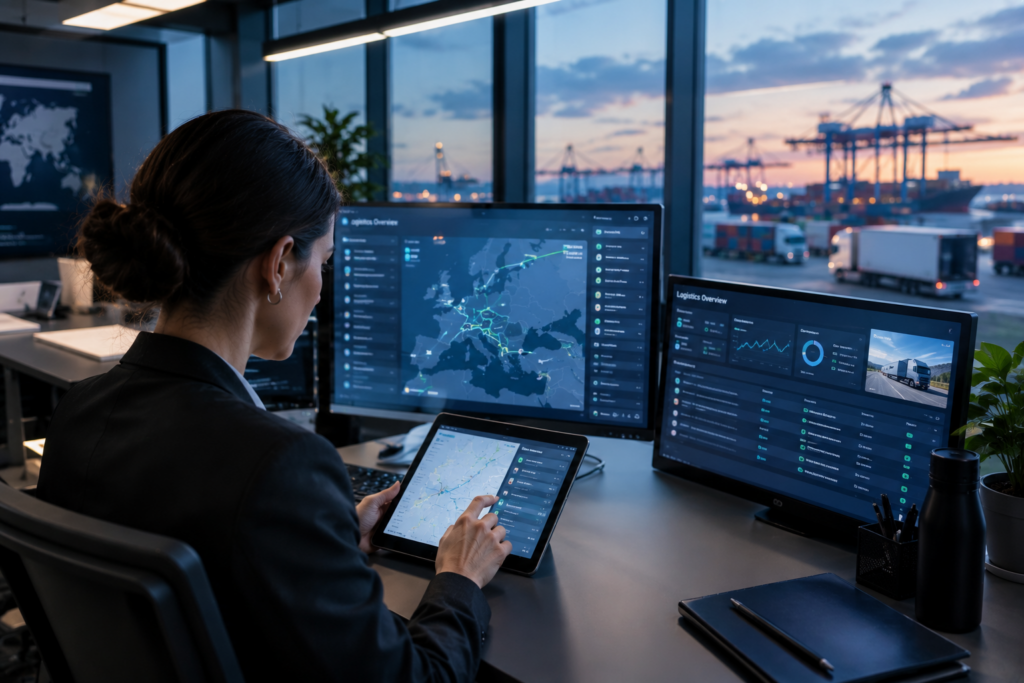
One of Cadenity's key pillars is visibility. The platform allows users to view the main elements of operations in a single view, eliminating the need to constantly switch between separate portals for each carrier.
In addition, Cadenity automatically detects certain issues, including delays, POD gaps, and missed scans. This allows the team to identify areas requiring attention sooner.
The platform also allows users to work with delivery-related indicators. Caden can answer queries about the percentage of on-time deliveries from different carriers or compare average delivery times by destination, carrier, and service.
Thus, a logistics software It is not limited to storing information, but can facilitate its consultation and help teams to better understand what is happening in operations.
Connectivity without changing existing systems
Implementing a new technology platform can raise concerns when a company already has an ERP, TMS, and various transportation systems. Cadenity is committed to a zero-disruption approach to ensure that platform adoption doesn't require migrating data or modifying existing processes.
The platform connects with carriers and systems using formats that companies already handle, including CSV, ERP, and TMS. According to Cadenity, the visibility and detection phase can be active in days, without the need for lengthy integration projects.
This possibility allows incorporating a logistics software progressively. The company can start with visibility and incident detection and later activate new capabilities according to its priorities.
Furthermore, integration with ERP and TMS systems is activated progressively according to each client's needs. This allows Cadenity to be integrated into existing operations without replacing the systems already part of daily functioning.
From detecting an issue to working on its resolution
Detection is only one part of incident management. Receiving an alert about a delay doesn't eliminate the problem. The team needs to analyze what happened, assess the alternatives, and decide how to proceed.
Cadenity addresses this aspect through its AI Orchestration Center. The platform enables a progression from detection to coordinated resolution. Artificial intelligence detects, analyzes, and proposes options, while the final decision always remains with a human.
This human-in-the-loop approach allows for a combination of automation and supervision. Every action requires human approval, and decisions are recorded with complete traceability.
According to Cadenity, the AI Orchestration Center can manage issues such as delays, partial deliveries, returns, POD gaps, and SLA risks. Autonomous execution capabilities are activated progressively based on customer needs.
Therefore, a logistics software AI-based technology can help teams reduce manual tasks without eliminating control over decisions that affect operations.

Caden, an AI agent specializing in logistics
Caden is Cadenity's AI agent specializing in logistics. It is designed to understand the specific vocabulary of logistics operations, including shipments, OTD, incidents, routes, and carriers.
Furthermore, it allows for queries using natural language without requiring SQL knowledge or file exports. This makes it easier for teams to directly access information related to their work.
For example, Caden can answer questions about the main delivery issues, compare average times by destination, carrier and service, or show carrier rankings based on the percentage of on-time deliveries.
Thus, the logistics software It incorporates a conversational layer that facilitates access to data and allows users to consult operational information more easily.
Artificial intelligence applied to logistics allows for the combination of data, visibility, and analytical capabilities on a single platform. Cadenity is committed to this model through a solution connected to existing systems and carriers, designed to keep the human operator involved in the decision-making process.
Ultimately, the evolution of logistics management is not just about having more data, but about being able to access it quickly, detect what is happening, and use artificial intelligence to help teams take action. logistics software as Cadenity proposes this transition towards a more connected, visible and autonomous management, while maintaining human control.