How artificial intelligence helps centralize shipments, detect incidents, and improve operations
Managing a transport operation involves working with numerous shipments, carriers, routes, and incidents. When each carrier uses its own systems and formats, operations teams can end up spending a significant portion of their time consulting portals, cross-referencing information, and manually updating files.
In this context, a transport management software It can help centralize information and offer a more complete view of what's happening in operations. However, technology applied to transportation can go beyond simply displaying data. Artificial intelligence allows for the detection of incidents, the analysis of information, and helps teams move from alert to resolution.
Cadenity proposes this approach through an agentic AI platform for logistics and supply chain, designed for companies that work with multiple carriers and need to reduce manual tracking and reactive incidents.
Centralize information from different carriers
One of the main challenges of multi-carrier operations is information fragmentation. Each carrier may use different terminology and provide shipment data in their own formats. This makes it difficult to get a unified view when the team needs to check the status of the entire operation.
Cadenity allows you to centralize data from different carriers and standardize it into a common taxonomy. Currently, the platform can automatically ingest information from DHL, MRW, and other carriers using CSV files.
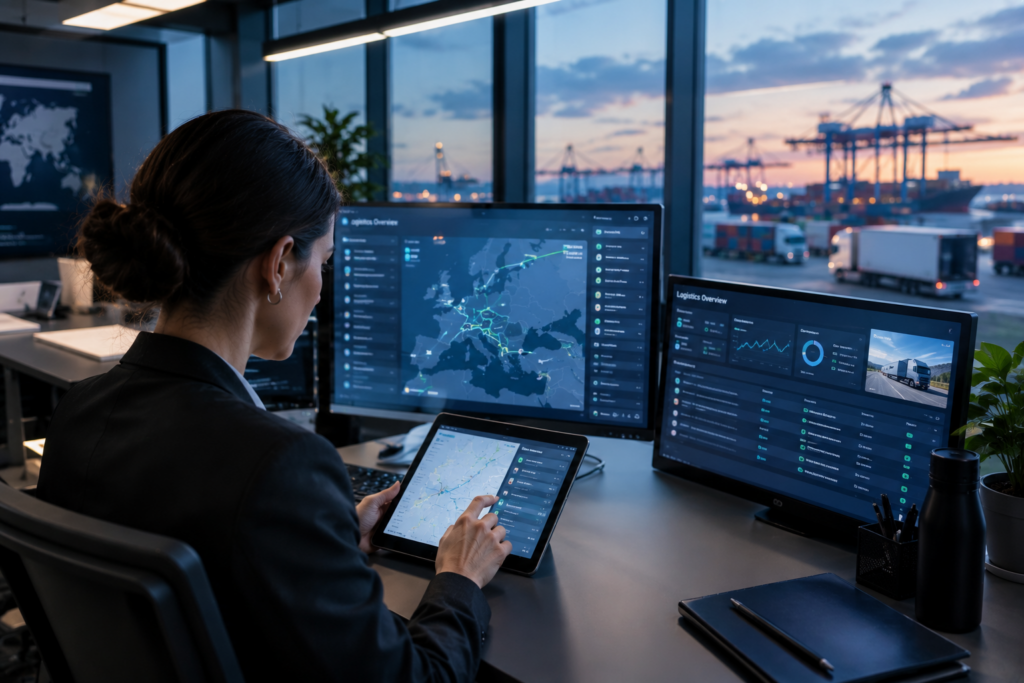
In this way, a transport management software It can become a central hub for tracking shipments without relying on multiple portals. Cadenity brings together shipments, carriers, routes, and incidents in a single view, providing real-time visibility into operations.
This centralization also allows for working with more homogeneous information. Instead of interpreting the states of each carrier individually, the data is normalized to facilitate analysis and monitoring.
Real-time visibility to detect incidents
Visibility is especially important when incidents occur that could affect deliveries. A delay, a partial delivery, a return, or a POD-related issue requires rapid notification so the team can analyze the situation.
Cadenity offers automatic incident detection in seconds and allows users to receive alerts related to different operational situations. In addition, the platform can display indicators such as on-time deliveries, incidents by carrier and route, carrier rankings, performance maps, and comparisons with previous periods.
Therefore, a transport management software It should not only allow users to check the location of a shipment, but it can also help identify patterns and problems within operations, giving teams a more complete overview.
Cadenity also allows you to generate scheduled Excel reports with information on incidents, delays, and snapshots, without requiring the team to prepare them manually. Alerts can also be emailed to designated team members.
Integration without migrations or changes in operations
Implementing a new technology solution can be complex when a company already uses different systems. For this reason, Cadenity is committed to a zero-disruption model: working on the existing infrastructure without replacing current systems.
The platform can connect with carriers and use formats already handled by companies, such as CSV. It can also integrate ERP exports and work alongside the TMS. Cadenity indicates that the visibility and detection phase can be operational in days, without lengthy integration projects.
This allows incorporating a transport management software progressively. Instead of proposing a complete replacement of existing technology, Cadenity builds upon current systems to add visibility, intelligence, and automation capabilities.
Connections to direct carrier APIs, certain ERP and TMS systems, such as SAP TM, are incorporated during the activation phase according to the technology stack and operational priorities of each client.
From the detection of an incident to its resolution
Detecting a problem is only the first step. Once an issue is identified, the team needs to gather information, analyze the alternatives, and decide how to proceed. In a traditional operation, this process can involve calls, emails, queries in different systems, and copy-and-paste tasks.
Cadenity addresses this process through its AI Orchestration Center. The AI detects the incident, gathers available context, analyzes the situation, and generates resolution options with information on their confidence level, financial impact, and effect on the SLA. The operator then reviews and approves the option before the action is executed.
Human approval is a core element of the system. AI proposes solutions, but the final decision always rests with a person. Furthermore, all actions and decisions are recorded through an auditing system that provides complete traceability.
Currently, Cadenity indicates that the AI Orchestration Center manages issues such as delays, partial deliveries, returns, POD gaps, and SLA risks. Autonomous execution via direct carrier APIs is being implemented progressively on a customer-specific basis.
View operations using artificial intelligence
Another of Cadenity's capabilities is Caden, its AI agent specializing in logistics. It is designed to understand terms related to shipments, OTD, incidents, routes, and carriers, and allows users to make queries using natural language in Spanish and English.
With Caden, teams can directly query their shipping data without using SQL or exporting files. For example, they can check the main delivery issues, compare average delivery times by destination, carrier, and service, or request a ranking of carriers based on on-time delivery percentage.
Thus, a transport management software It incorporates a new way of accessing information. The user does not need to know how the data is structured to ask a question about the operation.
In addition, Caden can generate executive summaries of the dashboard with three prioritized insights and maintains the context of the conversation to facilitate follow-up questions. It can also be integrated as a widget into other internal client tools.
A more connected and autonomous transport management
The evolution of transport management hinges on providing teams with centralized information and enabling them to act on it more quickly. To achieve this, simply gathering data is not enough: it also requires standardizing the data, detecting incidents, and facilitating its analysis.
Cadenity combines these elements into a platform that offers connectivity with existing carriers and systems, real-time visibility, and artificial intelligence capabilities to analyze and coordinate incident resolution.
In this sense, a transport management software It can become a tool for reducing manual tasks and improving operational control. Information is centralized, incidents can be detected earlier, and teams have tools to analyze them without constantly relying on manual processes.
Furthermore, Cadenity's approach keeps the human operator within the decision-making process. Artificial intelligence detects, analyzes, and proposes, while decisions and actions remain under human supervision.
Ultimately, the combination of connectivity, visibility, and artificial intelligence allows us to move towards more integrated transport management. transport management software Cadenity proposes this evolution without requiring migrations or changes to existing systems, making it easier for companies to incorporate new capabilities gradually.